





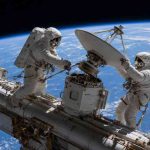



NASA temporarily directed five astronauts aboard the International Space Station to shelter inside a docked SpaceX Dragon capsule while Russian cosmonauts worked to repair a long-standing air leak in one of the station’s aging modules.
The precautionary move highlights ongoing maintenance challenges aboard the orbital laboratory, which has remained continuously occupied for more than two decades as international space agencies prepare for the station’s eventual retirement later this decade.
NASA Takes Precautionary Safety Measures
“Out of an abundance of caution, NASA has directed all four of the agency’s SpaceX Crew-12 members and NASA astronaut Chris Williams to assume an elevated safety posture in the Dragon spacecraft while the repair is underway,” NASA spokesperson Bethany Stevens said in a statement posted on X.
The issue involves a persistent air leak in the PrK transfer tunnel connected to Russia’s Zvezda service module, one of the oldest sections of the International Space Station. According to NASA, the leak is believed to stem from small cracks that have developed over time.
Russia’s space agency, Roscosmos, has managed the problem for several years through operational procedures and periodic repair work designed to limit the leak’s impact.
Long-Running Leak Returns After Temporary Stability
NASA said previous mitigation efforts had kept the situation under control until recent months, when the leak rate increased again. That development prompted what the agency described as a more extensive repair operation on Friday.
While NASA did not disclose technical details about the repair process, the agency said the temporary relocation of astronauts into the SpaceX Dragon capsule was intended as a safety precaution during the work.
The International Space Station operates in low Earth orbit roughly 250 miles above the planet, where maintaining cabin pressure is critical for crew safety. Even relatively small leaks can become significant concerns if left unresolved over time.
Crew Members Shelter Inside SpaceX Dragon “Freedom”
The astronauts who sheltered inside the Dragon spacecraft included NASA astronauts Jessica Meir and Jack Hathaway, European Space Agency astronaut Sophie Adenot, and Russian cosmonaut Andrey Fedyaev, all members of SpaceX Crew-12.
The group arrived at the station in mid-February for a planned six-month mission focused on scientific research, station maintenance, and technology demonstrations.
They were joined inside the Dragon capsule, named “Freedom,” by NASA astronaut Chris Williams, who traveled to the station in late November aboard a Russian Soyuz spacecraft.
Williams arrived alongside Russian cosmonauts Sergey Kud-Sverchkov and Sergei Mikaev, who are believed to have carried out the repair operation. NASA did not officially confirm which crew members conducted the work or provide additional information about the repair procedures.
Aging Space Station Faces Increasing Maintenance Challenges
The incident underscores the growing technical challenges associated with maintaining the International Space Station as it ages. First launched in 1998, the station has relied on cooperation among NASA, Roscosmos, the European Space Agency, Japan’s JAXA, and the Canadian Space Agency.
NASA and its international partners have repeatedly emphasized that the station remains safe for crews despite recurring maintenance issues. However, officials have acknowledged that aging hardware will likely require more frequent monitoring and repairs in the coming years.
The United States plans to transition from the ISS to commercially operated space stations after the current orbital laboratory is retired, potentially by the end of the decade.
For now, mission teams continue to manage technical problems as astronauts and cosmonauts carry out daily operations aboard humanity’s only permanently occupied outpost in space.

Cohen is a contributor at Houstonian Online, covering a variety of topics including news, politics, business, technology, sports, entertainment, and lifestyle. With a focus on clear reporting and useful information, Cohen helps readers stay informed about current affairs, emerging trends, and stories that are relevant to their daily lives.